
If you've gone looking for a way to lucid dream more often, you've almost certainly run into binaural beats, sometimes even wrapped in confident promises that the right frequency will unlock your dreams tonight. I've practiced meditation for over three decades, and I want to give you something most marketing pages won't: an honest answer. Or at least an attempt to give you an honest answer. So, do binaural beats actually help you lucid dream? And what does the evidence really show? And if you want to try them, how do you do it in a way that helps rather than just adds noise?
What are binaural beats, briefly?
The mechanism is simple. Play a tone of one frequency in your left ear and a slightly different one in your right, and your brain perceives a third, pulsing "beat" at the difference between them. Play 200 Hz on one side and 206 Hz on the other, and you'll seem to hear a soft 6 Hz pulse — even though that pulse doesn't exist in the room. It's created inside your head, which is why headphones are not optional. Without them, the two tones simply mix in the air and the effect disappears. That's the whole trick: a perceived rhythm your brain assembles from two slightly mismatched tones.
If you are uncomfortable using headphones, the same effect can be achieved using isochronic tones. If that is your thing, then just read isochronic tones every time this article mentions binaural beats.
The theta-wave theory and why people connect them to dreaming
Here's the reasoning you'll see everywhere. Your brain produces different electrical rhythms in different states: slower delta waves in deep sleep, theta in light sleep and certain meditative or drifting states, alpha in relaxed wakefulness, and so on. Dreaming, and the REM sleep where most vivid dreams happen, is associated with particular patterns of brain activity.
The theta range — roughly 4 to 7 Hz — sits in that drowsy, hypnagogic, half-asleep territory that lucid dreamers know well. So the theory goes: if you feed your brain a theta-frequency binaural beat, you might nudge it toward the state where lucid dreams become more likely. It's a tidy, intuitive idea. It's also where we need to slow down and look at what's actually been demonstrated.
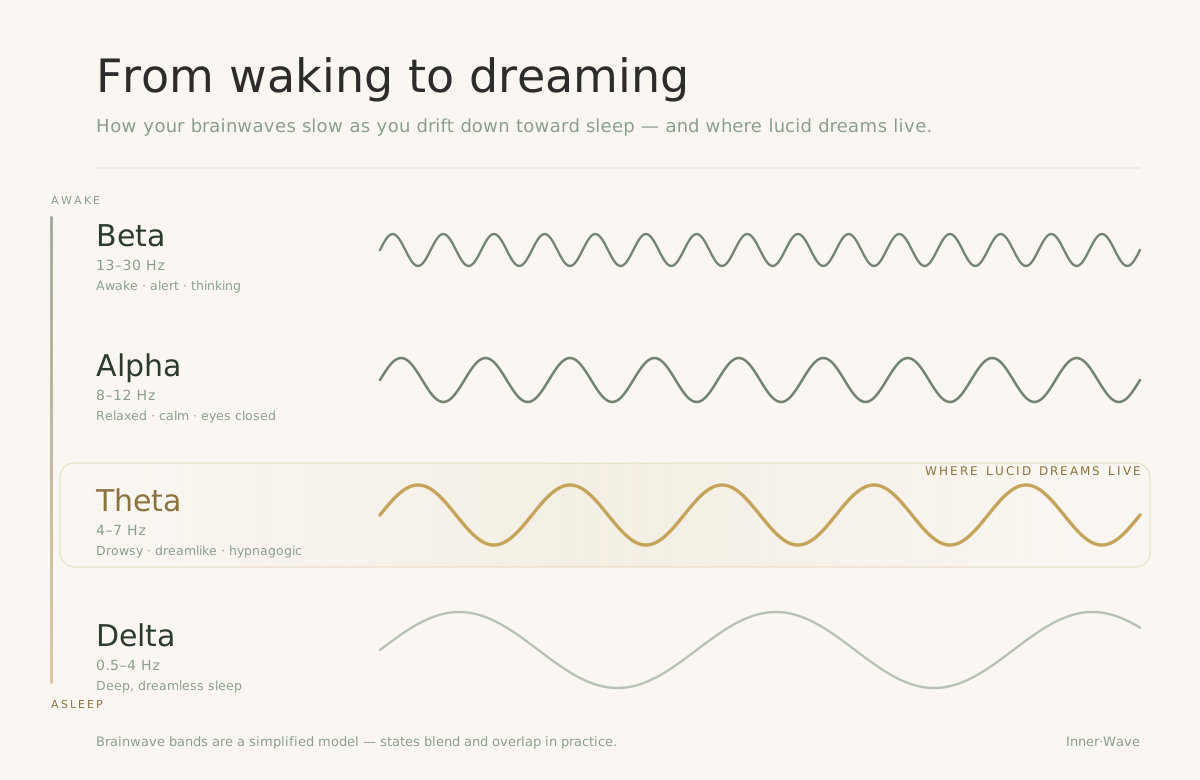
Brainwave bands and their relevance to sleep and lucid dreaming.
| Brainwave | Frequency | Mental state | Relevance to dreaming |
|---|---|---|---|
| Beta | 13–30 Hz | Alert, active thinking | Everyday waking focus — too "awake" for sleep onset |
| Alpha | 8–13 Hz | Relaxed, calm wakefulness | The settling-down stage before sleep |
| Theta | 4–7 Hz | Drowsy, hypnagogic, deep meditation | The drift state lucid dreamers target |
| Delta | 0.5–4 Hz | Deep, dreamless sleep | Restoration — not where lucidity tends to happen |
What the evidence actually shows
Well, there is no direct scientific evidence that binaural beats cause or reliably induce lucid dreams. No controlled study has shown that listening to a particular frequency makes lucidity happen.
Step back to binaural beats in general, not even lucid dreaming, just their effects on the brain and mood, and the picture stays murky. The published research is inconsistent. A handful of small studies suggest modest effects on things like attention, anxiety, or memory, but a roughly equal number find no measurable effect on brainwave activity, heart rate, or other physical markers. And a fair share of the encouraging studies come from groups with a commercial interest in selling the technology, which is a reason for caution rather than confidence.
This doesn't mean binaural beats are worthless. It means the honest summary is: the theory is plausible, the hard evidence is thin, and anyone promising guaranteed results is overselling. If a tool's marketing is more confident than its evidence, that's worth noticing, and most binaural beat marketing is far more confident than its evidence.
And notice what the studies tend to be: short, single-session, often bare-tone, measuring cognition or mood in a lab — not someone running a theta-and-rain mix nightly while practising MILD for a month. That gap matters. The absence of a study on your way of using it isn't evidence against it; it just means it's barely been looked at. Which is the honest case for treating your own weeks of practice as the real test.
So why do people swear by them?
Because plenty of people genuinely do find them helpful, and there are good, non-magical reasons for that.
The first is relaxation. Lucid dreaming has a cruel paradox at its center: the harder you strain to make it happen, the more that tension keeps you awake and pulls you out of the relaxed, drifting state where lucidity actually arises. Dream researchers have pointed out for years that the pressure to perform is counterproductive. A calming theta soundscape can quietly defuse that pressure; not by flipping a switch in your brain, but by helping you let go and fall asleep without the anxious effort. And the calmer and more relaxed you are as you drift off, the more likely lucidity becomes anyway.
The second is attention. Many lucid dreaming techniques work by holding a single, steady focus, an intention, a phrase, an awareness, as you fall asleep. A soft, continuous sound gives your attention something gentle to rest on, an anchor that isn't the spinning to-do list that accompanies most of us when we try to fall asleep.
The third is expectation. If you believe the beats will help, that belief shapes your experience, both your relaxation going in and how you interpret what happens. That's the placebo effect, and it's not nothing. But it does mean the beats themselves may be doing less of the work than the ritual around them.
None of this requires the beats to be a scientifically proven dream trigger. It just requires them to be a calming, focusing part of a sensible practice. That's a much smaller, much more defensible claim. And it happens to be true.
How to actually use them
If you want to experiment, and experimenting is the right spirit here, this is how to do it so it supports your practice instead of just being background noise.
Use headphones. As above, the effect doesn't exist without them. Comfortable ones you can sleep in, if you're using them as you drift off. I have good results with earbuds designed for sleep, like the ones from Ozlo or Wavell.
Start in the theta range. It's the usual starting point for dream and sleep work. If your tool — like the free binaural beats generator — lets you set an exact frequency, something around 6 Hz is a common target; if it only offers named bands, "theta" is the one. Treat it as a starting place to experiment from, not a magic number.
And keep in mind, here's a practitioner's approach the studies haven't actually tested, so take it as experience rather than evidence: start the session near your waking rhythm, perhaps 12–14 Hz, and lower it roughly 1 Hz per minute, giving the mind a good 5–10 minutes to ease down toward the theta band around 6 Hz. It may simply be a gentler way in. I find it helps; I can't point you to a trial that proves it.
Keep the volume low. This should help you relax, not keep you alert. If you're noticing the tones, they're probably too loud.
Layer them under something softer. Bare binaural tones can be harsh and clinical, sometimes not exactly sleep-inducing. Most people do far better with the beats sitting quietly underneath an ambient sound like rain or soft night noise. The ambience makes the whole thing sleep-friendly and masks the strangeness of the pure tones. This is actually why I build the way I do: in the app I work on, Inner·Wave, you can set a theta beat low in the mix under rain, soothing music and a gentle guiding voice, rather than enduring naked tones. Build it however suits you, the point is comfort.
Pair the audio with a real technique. This is the big one. Binaural beats are a support, not a method. They work best alongside an actual lucid dreaming practice:
- setting a clear intention to recognize you're dreaming (MILD)
- staying aware as you fall asleep (WILD)
- doing reality checks through the day, and keeping a dream journal.
The audio sets the stage; the technique does the work.
Favor consistency over the perfect track. A modest routine you actually keep beats an elaborate setup you use twice. Same frequency, same ambience, same intention, most nights, I find that to be most helpful.
A note on expectations
Lucid dreaming is a skill, and skills take weeks of patient practice. No frequency, no app, no soundscape is a shortcut around that. The most useful way to think about binaural beats is as one small, optional tool in a broader practice, a way to relax, focus, and settle into the right headspace, rather than a button that produces lucid dreams on demand. In my humble experience, and to much regret, such a button does not exist.
I'd gently suggest holding the whole thing lightly. Try it for a few weeks. Notice honestly whether it helps you relax and whether your recall or lucidity shifts. Keep it if it does, drop it if it doesn't. Your own experience over a few weeks is worth more than any frequency chart.
The honest bottom line
The theta-wave theory is genuinely interesting, and the relaxation it can bring is real and useful. But the hard evidence that binaural beats cause lucid dreams isn't there, and you should be wary of anyone who tells you otherwise. What's true is quieter and more practical: a calm theta soundscape, used alongside a real technique and realistic expectations, can be a pleasant and supportive part of a lucid dreaming practice.
Try it for yourself, pay attention to what actually happens, and let your own experience be the judge.
Common questions
Do binaural beats really work for lucid dreaming?
There's no direct evidence that binaural beats cause lucid dreams. What they can do is help you relax and focus as you fall asleep, which indirectly supports lucidity. Treat them as a calming aid alongside a real technique, not a trigger.
What frequency is best for lucid dreaming?
Most people use the theta range, around 4–7 Hz, with 6 Hz a common target. Theta matches the drowsy, half-asleep state lucid dreamers work with. Treat it as a starting point to experiment from, not a guaranteed magic number.
Do you need headphones for binaural beats?
Yes. The beat is created inside your brain from two slightly different tones, one in each ear. Without headphones the tones simply mix in the air and the effect disappears. If headphones are uncomfortable, use isochronic tones instead.
How do I use binaural beats with a lucid dreaming technique?
Keep the volume low, layer the beats under softer ambience like rain, and pair them with a real method such as MILD, WILD, reality checks and a dream journal. The audio sets the stage; the technique does the work.